


The Passive Seismic Investigation within the MARE project is designed to unlock the hidden potential of seismic data as a powerful proxy for observing the ocean. Its primary objective is to transform continuous ground motion recordings into reliable, high-resolution information about sea state and wave energy.
At its core, this activity aims to quantify the spatial and temporal distribution of wave energy in the waters surrounding the Egadi Islands. By doing so, it provides a solid scientific basis for evaluating the feasibility of marine renewable energy systems, particularly those based on wave energy conversion.
Beyond measurement, the project seeks to advance predictive capabilities. Through the integration of seismic observations with numerical models and artificial intelligence, Passive Seismic Investigation contributes to the development of tools capable of forecasting sea conditions in near real time. These tools are essential not only for optimizing energy extraction but also for improving maritime safety and operational planning.
Another key objective is methodological innovation. By refining techniques that extract oceanographic information from seismic noise, MARE promotes a non-intrusive and cost-effective monitoring strategy, reducing the need for extensive in situ instrumentation while maintaining high accuracy and continuity of observations.
Ultimately, the goal is to establish a new paradigm in marine monitoring—one in which seismic networks, originally designed for solid Earth studies, become an integral component of sustainable ocean energy assessment and environmental observation systems.
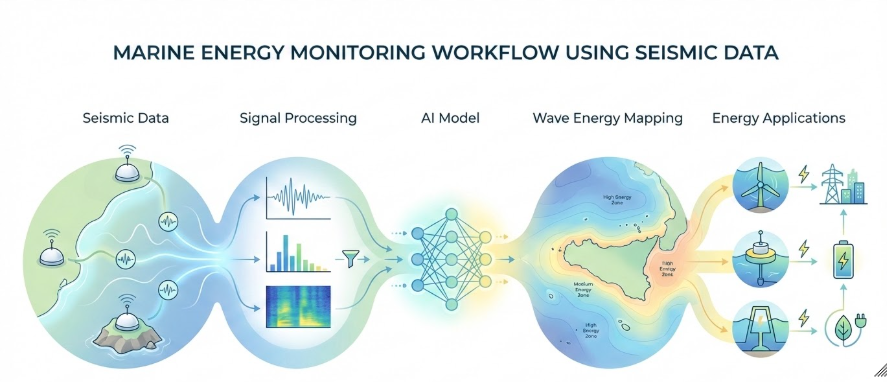
Figure 1. From seismic observations to sustainable energy: the MARE framework links Earth monitoring to marine renewable energy applications.